Office of the Assistant Secretary of the Air Force for Energy, Installations, and Environment
The Air Force is offering up large parcels of land – approximately 100 to 550-plus acres – for lease around the inside perimeter of Edwards Air Force Base to tech companies looking for large data center sites, e.g., the 200k ft.², loud-humming, HVAC & power-heavy data centers that house AI, cloud, enterprise, and other data storage and processing.
The lease opportunities are long-term, typically 50-plus years, and all part of a War Department initiative to enhance the physical (back-up base power tie-ins) and fiscal (in-kind revenue sharing towards base gyms, chapels, etc.) sustainment of our nation’s installations while spurring economic growth at a cost that is not just affordable, but appealing to big industry.
Of the seven parcels available at Edwards, four are in Kern County (1,100-plus acres) and three in Los Angeles County (1,000 acres). All are near existing transmission lines (with room for attached solar or geo-thermal development) as well as environmental rights-of-way for fiber. None are near populated areas, and all enjoy the security and tax benefits of military-patrolled federal property.
- 10 USC § 2667 authorizes installations to lease underutilized, non-excess real property in return for the payment of cash or in-kind consideration in an amount not-less-than the fair market value of the lease interest
- California Installation Identified: Edwards AFB, Rosamond CA
- Proposed lease term is 50 years
- More than 100 acres per site
- Edwards AFB parcels
 Site 1: ~347 acres and 166 acres split by a railroad.
Site 2: ~330 acres
Site 3: ~567 acres
Site 4: ~136 acres
Site 5: ~455 acres
RFP Submission
Request for Lease Proposal is here – this is where companies can post proposals. Offers for this round must be submitted by Nov. 14 (this may change), with source selection approval, by Jan. 12.
Utility Information
- Natural Gas pipeline to the base and nearby – PG&E; Geothermal potential in the geographic region
- California is a deregulated market; however, investor-owned utilities (SCE) can own generation
- NE corner of the base has a substation (SCE) with 220KV and 500KV located immediately outside the fence line – owned by LADWP.
Contact Information
David Mairs, Lackland AFB in San Antonio, TX
[email protected], 361-290-3400
The Department of Air Force is moving forward with plans to host Artificial Intelligence data centers on underutilized land at select Air Force bases through a lease of property. This effort is a response to Executive Order 14179: Removing Barriers to American Leadership in Artificial Intelligence dated Jan. 23, and Executive Order 14318: Accelerating Federal Permitting of Data Center Infrastructure dated July 23. On Oct. 15, a solicitation was released stating the DAF is seeking qualified entities for a long-term lease to develop and operate these data centers, supporting innovation and technological advancement. This list of frequently asked questions provides answers to anticipated questions and concerns about this process.
Who will own and operate the data centers built on Air Force land?
The AI Data Centers will be owned by private entities selected from a competitive process. These private entities, who will lease the real property from DAF, are responsible for financing, constructing, operating and maintaining the Data Centers.
How does the DAF benefit from this initiative?
In consideration of leasing its land, the DAF will receive cash and/or in-kind consideration of monetary value. Additionally, at installations where a developer proposes a dedicated energy source for a Data Center, the DAF is requiring first right of refusal of power during a grid outage. Any power the installation obtains from the developer will be negotiated separately.
Which installations were selected for this opportunity?
The DAF offered land for AI Data Center development at five installations: Arnold AFB, TN, Edwards AFB, CA, Joint Base McGuire-Dix-Lakehurst (JBMDL), NJ, Davis-Monthan AFB, AZ, and/or Robins AFB, GA. The DAF selected these installations based on market analysis, infrastructure availability, and strategic importance. The DAF may consider other installations in the future.
What Government missions are expected to be hosted on these data centers or require on-premise data centers at this scale and size?
AI Data Centers at DAF installations are not meant to primarily support mission data requirements but will primarily support commercial use. The DAF is neither requiring nor guaranteeing DAF use of any on-site AI Data Centersproposed in response to this solicitation. Although not currently contemplated, if the owners were to successfully market utilization of an on-base AI Data Center to a DAF customer, this would be a separately negotiated agreement by the associated DAF component outside of the lease transaction.
Can you tell us how energy and water usage will be factored into the evaluation of these proposals, to include potential impacts on the availability of those resources both to the installation and surrounding communities?
Data centers can utilize substantial energy and water. The Request for Lease Proposal (RFLP) requires offerors to provide a mitigation and contingency plan to ensure the installations and surrounding communities’ utilities service life, resiliency, and capacity are not impacted. Offerors must also address site specific energy markets and other factors such as Regional Transmission Organizations and Independent Systems Operators conditions based on the project development location. For regulated utility markets, the offerors are required to identify how the project will be supported by local electric, gas, communication network and water utilities. Additional coordination will be required for deregulated utilities. Water efficient technologies are of heightened interest.
Have state and local governments and utilities been informed of these potential leases as the data centers could have impacts on both energy/water availability and costs for surrounding communities?
The DAF is requiring offerors to demonstrate in their proposals how they would minimize and mitigate impacts and risk to the surrounding community, specifically related to the access to and affordability, reliability, and quality of energy, water, and communication bandwidth. Offerors will also be required to demonstrate how their proposal will be compatible with the surrounding community; minimize environmental, cultural, and infrastructure impacts; be consistent with best commercial practices; and support positive relations with State and local government authorities and the communities adjacent to the properties. Once best value lease applicants at different sites are selected, the DAF will ensure appropriate National Environmental Policy Act (NEPA) and other required regulatory reviews are properly accomplished before entering into a lease.
Will there be an EIS required if we move forward?
The DAF will require compliance with the National Environmental Policy Act (NEPA) and other applicable laws. The NEPA requirements will be assessed once the DAF approves the preliminary scope of work, proposed by the selected applicant at each location, is sufficiently developed and prior to lease closing.
Will projects less than 100 MWs of compute capacity be considered?
Given the realities of utility capacity constraints and onsite generation development timelines, phased projects will be considered as long as they are structured to reach or surpass 100 MWs of capacity in a reasonable timeframe. The DAF is interested in large-scale developments and would like to see good faith bids which provide a roadmap for phased development if appropriate.
Will construction tradesmen and eventual data center operators be required to go through base security daily and be subject to respective background checks?
DAF will make every effort to work with the eventual lessee to establish a new perimeter (move the fence) to provide site access separate from installation security if feasible. However, if that is not feasible given the location of the respective parcels, then personnel associated with the data center development will be required to meet installation security requirements.
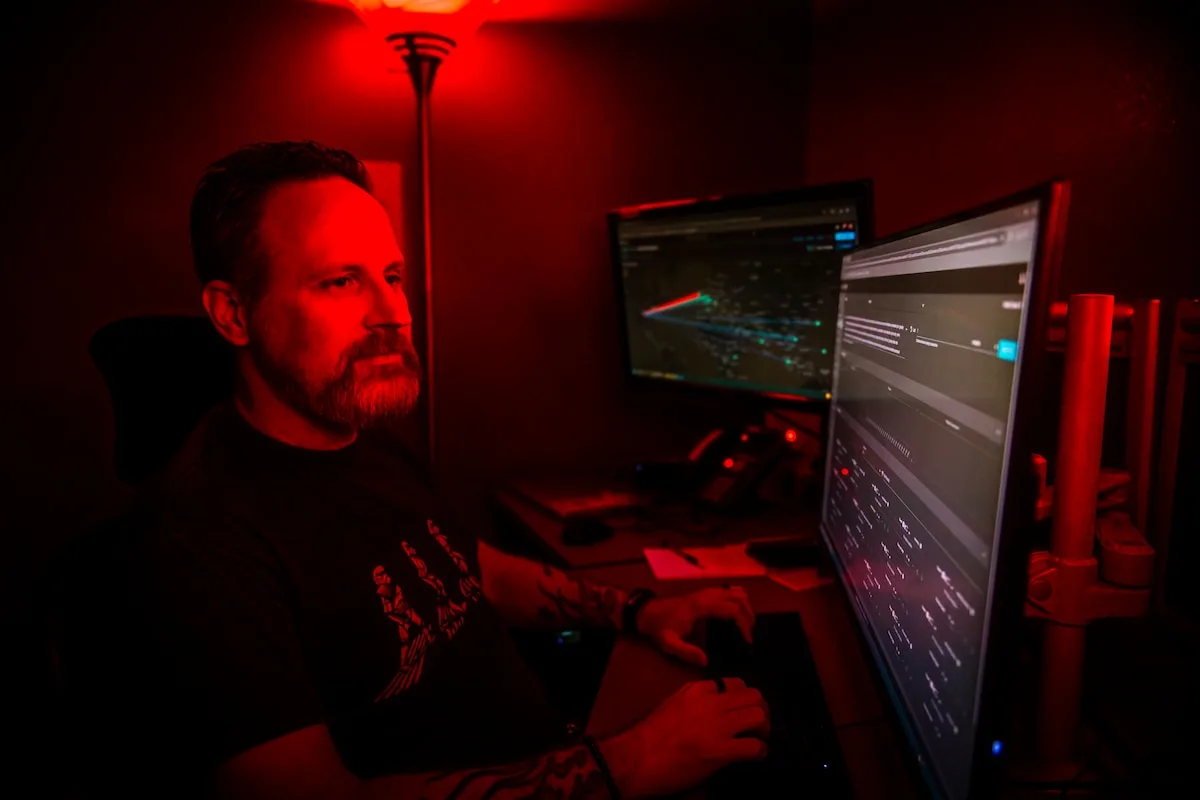
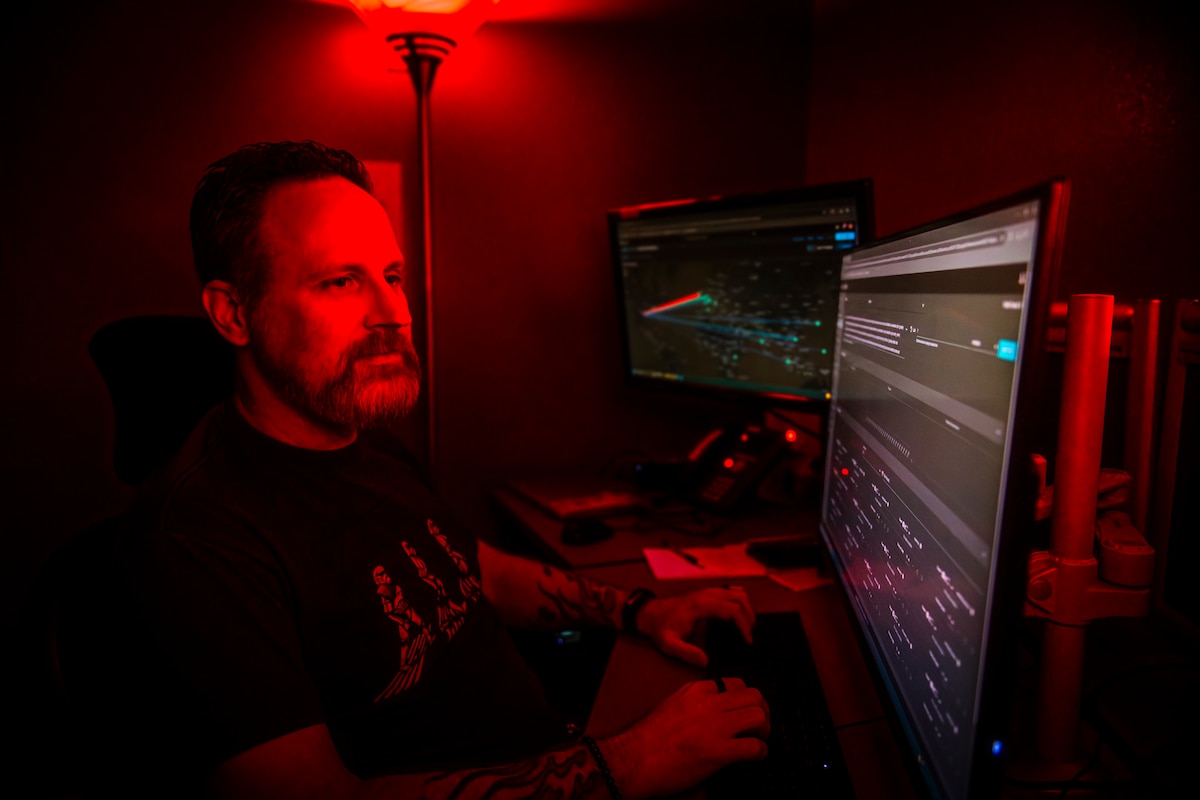
 Lonnie Dierkson, 412th Communications Squadron, REDCORE operations lead cyber defense operator, demonstrates his team's counter-cyber-attack capabilities on Edwards Air Force Base, California, recently. The Research, Development, Test & Enterprise Defensive Cyber Operations Response Element (REDCORE) provides continuous cyber defense for 412th Test Wing and Air Force Test Center assets on Edwards (Air Force photo by Giancarlo Casem).